From the AlzAuthors Blog: Occupational Therapist Barbara Smith Teaches Alzheimer’s Caregivers New Skills in “Still Giving Kisses”

Smith, Barbara graphic copy (1)

By Barbara Smith

I am an occupational therapist, specializing in developmental disabilities. I had never planned to work in the area of geriatrics. But when my mother developed Alzheimer’s disease, I was thrust into the world of home care, Medicare, assisted living and nursing homes. I read numerous books and learned the lingo of lawyers, the health care bureaucracy and gerontology.

Fortunately, as an occupational therapist, I have years of experience adapting environments and creating activities to promote functional skills and quality of life. I wrote this book to share how I helped my mother enjoy her life as best as possible, as she regressed through the stages. I could not help but notice that the residents in my mom’s assisted living and then her nursing home had few visitors.

I believe that there are many reasons for this, but common ones are:

  • Friends and loved ones are scared and confused about the person’s decline
  • Friends and family do not know how to relate to a person who may no longer speak or seem to recognize them.
  • And most sadly, friends and family think that the person has so little awareness that their presence is of no value.
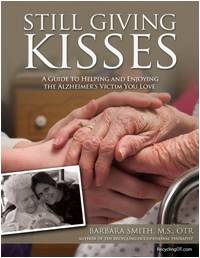
still giving kisses copyMy primary goal in writing Still Giving Kisses: Helping and Enjoying the Alzheimer’s Victim You Love was to offer an alternative to the above situations. Like many others, I was in the “sandwich generation.” My son was a tween and teen during these years and had many developmental and social challenges related to autism. The time crunch from work and family obligations naturally made spending time with my mom difficult–as I’m sure is true for millions of other caregivers. However, when loved ones learn how to help and actually enjoy being with this person, the relationship takes on a beautiful and mutually beneficial meaning. Given the right information and support, family and friends can learn how to spend quality time with a loved one that will create positive memories.

The title of this book reflects one of the few remaining motor acts my mother was able to perform during the last few months of her life. When she was no longer speaking, non-ambulatory and unable to eat independently, she was still able to pucker up her lips to communicate “I love you, come over for my kiss.” This was a highly significant motor act, one that symbolizes a continuing connectedness between myself and the Alzheimer’s victim I loved.

There are many books on the market that describe the symptoms and stages of Alzheimer’s disease and behavioral interventions that promote function. Often this information is dry and overwhelming. There are also many highly readable memoirs that give the spouse, adult-children or the victim’s point of view. In writing, Still Giving Kisses, I strove to provide both.

You will read a compelling memoir of a woman whose earlier mental health problems compounded the many challenges of memory impairment. The many therapeutic techniques, adaptations and teaching tools I share are all tricks of the occupational therapy trade, along with my own unique touch. Extensive resources and medical, legal and care-giving information provide survival tools.

Although I wrote this book primarily for friends and family of Alzheimer’s victims, Still Giving Kisses provides a framework for health care professionals entering the field of geriatrics. Indeed, I wish this resource had been available when my mother began showing the earliest symptoms. I hope that my book helps you to enjoy a journey that nobody chooses to take . . .

Purchase Still Giving Kisses

About the Author

Barbara Smith is an occupational therapist specializing in developmental disabilities. She discovered a penchant for creating highly effective therapeutic activities out of household materials such as detergent bottles, cardboard boxes and newspapers. Her book The Recycling Occupational Therapist describes how to fabricate and use these activities.

Barbara’s second book From Rattles to Writing: A Parent’s Guide to Hand Skills (published by Therapro, Inc. 2011) is written for parents with typically developing children from ages birth through five years to help develop the skills needed to read and write. In addition, the activity adaptations make learning easier for children with sensory, motor or sensory challenges.

From Flapping to Function: A Parent’s Guide to Autism and Hand Skills is written for parents of children who have or they suspect may have an autism spectrum disorder. Readers will learn how autism impacts the development of hand skills and to use the teaching strategies and adaptations that help children reach their potentials to perform everyday functional activities and academic skills in school.

Connect with Barbara Smith: books, courses, educational videos and social media

Website

Blog

Educational Videos

Facebook 

Twitter 

***

For more extraordinary books about Alzheimer’s and dementia
please visit the AlzAuthors Bookstore.
Reposted with permission of AlzAuthors, the global community of authors
and readers whose lives have been touched by Alzheimer’s and dementia.
I am a co-founder and admin.

Continue reading

From the AlzAuthors Blog: Michelle Spray Writes About Her Novel “Lost Memories Found Hope: A Granddaughter’s Story of Love throughout Alzheimer’s”

Spray,MichelleCanvaFeaturedImage

By Michelle Spray

I truly feel honored to be included as an integral part of the AlzAuthors group. Not only have I written a book with will make my grandmother proud, I have lived the caregiving experience one hundred percent. I was Grandma’s primary caregiver for seven years and got my on-the-job training simply because I lived there. It was up to me. I learned how to cope, distract, exercise patience, and lean on hope to get through all the emotions of dementia and eventually an Alzheimer’s diagnosis. I understand the stress that families are going through, including worrying and grieving for the Grandma I knew even though she was still alive. The day she no longer recognized me is a moment that will forever be etched on my heart.

Lost Memories front cover 2018I didn’t want to write a sad book about Alzheimer’s because that had already been done, so I used the opportunity to write a fictional story based on Grandma’s Alzheimer’s. I included the funny things she’d say, or how sometimes, even in the midst of it all, she would have a quick reply or joke, that always took me by surprise. At the end of the day, it would be these funny moments that helped me through all times I felt like crying; waiting for the mailman who already came, having her accuse me of stealing her teeth, telling me that the golden years weren’t really golden but instead a little rusty. When I’d ask her how she was feeling, she would tap the table and say, “with my hands.” Oh, how I miss her. Continue reading

From the AlzAuthors Blog: Carol B. Amos Shares “H.O.P.E. for the Alzheimer’s Journey”

Amos, Carol graphic copy

By Carol B. Amos

My two brothers and I were devastated when our mother began displaying signs of Alzheimer’s disease in 2002. She lived alone in her home and her nearest adult child lived four hours away. We banded together to face this challenge head-on. We began a period of observing, investigating, collaborating, and careful listening to gain insight into the situation. We visited and called our mother more often. We each solicited advice from caregivers we knew and visited our local Alzheimer’s Association office.

My brothers and I worked hard to help our mother maintain her independence and remain in her home. We worked with her doctors, and after multiple attempts Aricept was prescribed. We hired a social worker and nurse to assist her. When “issues” arose, we never knew if an event occurred as she explained. This was extremely frustrating to us. Eventually a dangerous incident demonstrated that she could no longer live alone. It was difficult taking responsibility for our strong, independent mother. Continue reading

From the AlzAuthors Blog: AlzAuthors Launches Its “Inspiration Collection” During Cruise Dementia Conference

AlzAuthors is thrilled to join a new cruise and conference designed for those living with early-stage Alzheimer’s, their caregivers, and their loved ones. The AlzAuthors Inspiration Collection: Extraordinary Books about Alzheimer’s and Dementia will sail to the Caribbean April 6-13 during the inaugural Connecting Circles of Care and Building Bridges of Hope Cruise & Conference, an empowering 7-day retreat experience that offers respite and education.

Lisa Chirico

“Our cruise and conference provide an opportunity for attendees to benefit from a wide range of programming created for their complex and stressful lives,” says Lisa Marie Chirico, Dementia Caregiver Cruise and Conference Producer. “Additionally, the tropical wonders and beauty of the Caribbean offer healing for both the body and the spirit, so it’s a perfect pairing.” Chirico was a full-time caregiver for her father, who had Alzheimer’s disease, and is passionate about supporting dementia caregivers and their families. She currently works as a Nursing Home Navigator Coach for clients experiencing long-term care at Nursinghomeology.com. Continue reading

From the AlzAuthors Blog: Jessica Bryan Returns with “The Mighty Ant – An Anthology of Short Stories for Seniors”

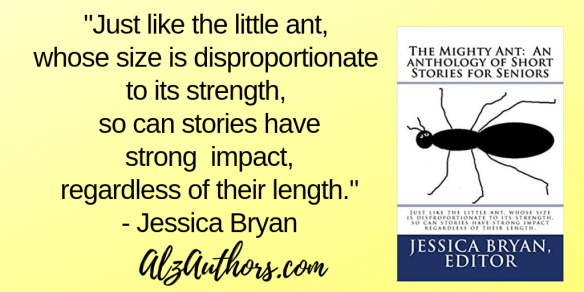
_just like the little ant, whose size is disproportionate to its strength, so can stories have strong impact, regardless of their length._
By Jessica Bryan

I am an author of over 28 books who has always shared my stories with my mother. Sadly, Mom suffers from Alzheimer’s, and as the disease has progressed she no longer comprehends more intricate plots, nor can she focus on longer, more detailed stories.  As a consequence, I began reading short stories to her. I noticed that after reading something more easily comprehended, there was often something in the tale that sparked a memory and conversation.  “Do you remember gardening?” I asked her after reading about a gardener. It brought a sweet reminiscent moment that included smiles and even laughter. That spawned my idea for a book of short stories specifically dedicated to the elderly with cognitive issues and their caregivers who often search for activities that will provide quality time with their loved ones. Continue reading

From the AlzAuthors Blog: Florrie Munat Shares her Lewy Body Caregiving Story in “Be Brave”

Florrie Canva

Love Remains

By Florrie Munat

“Are you going to write about this?” Chuck asked.

I stopped sorting the pile of laundry that a nursing home aide had just left on his bed and turned to look at my husband. Had we not been married for thirty-six years, I might not have known what he was talking about. But in addition to our long marriage, for the last two years I’d been supplying him with words he could no longer remember. So it took me only a few moments to figure out exactly what he meant.

He was referring to the soul-shattering changes that followed his stroke and Lewy body dementia diagnosis. Those changes had ended the chapter of our marriage when we lived together in equal partnership under one roof, and had begun the current chapter in which Chuck was a nursing home resident and I was his daily visitor. He was asking if I was going to write about those changes.

Back when I worked as a librarian and writer, and Chuck taught high school English and then edited a national classroom newspaper, our married life included some major changes (a cross-country move from Connecticut to Washington) as well as some tragedies (the death of his ex-wife, which led to my adopting his three young children).

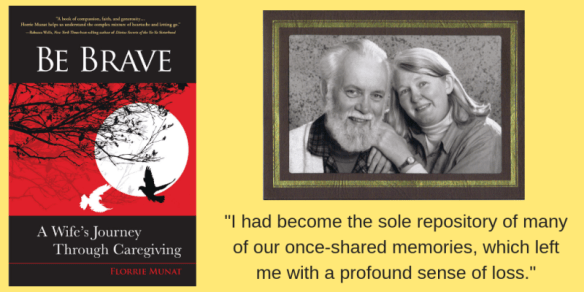
But those changes seemed simple compared to this one because I felt alone now. I had become the sole repository of many of our once-shared memories, which left me with a profound sense of loss.

By asking this question, Chuck was giving me permission to document and reflect not only on the cataclysmic events of the past two years, but also on however many years lay ahead of us. His question: “Are you going to write about this?” was also a request. If he’d been able to frame it differently, Chuck might have said, “It’s up to you to tell our story now because you’re the only one who can. And others may be helped by knowing what happened to us.”

Four more years passed before we had to say our final goodbyes, and during that time he continued to remind me, “Are you going to write about this?”

be brave cover imageHis question planted the seed that grew into my memoir, Be Brave: A Wife’s Journey Through Caregiving. He even gave me the title on the day he decided to stop eating and drinking and told me to “be brave.”

With the exception of one chapter about our family’s celebration of the Irish New Year shortly after Chuck’s dementia diagnosis, I wrote the first draft of Be Brave after Chuck died in 2009. Then, with the assistance of an insightful developmental editor and a talented book designer, I spent three years rewriting that draft—and in December 2017, Be Brave was finally published. Kirkus Reviews chose it as one of its Top Indie Books of 2017, calling it “a beautiful, richly panoramic book that should reassure caregivers and delight memoir readers.”

While I worked on Be Brave, I was processing my grief by writing and rewriting our story until I found some meaning in those six nursing home years by placing them in the context of our forty-year marriage. This is not to say I discovered a reason why our lives played out the way they did. That remains an unknowable mystery. And if I could have an intact, healthy Chuck back right now, I’d do it in a heartbeat.

But by writing our story, I did find some consolation embedded in our suffering. And that is that no matter how difficult life became during the caregiving years, our love for one another was never in doubt or in danger. In fact, had we not lived through those last six years, we would not have known the depth and magnitude of our love.

Like all good teachers, Chuck asked questions; he didn’t provide the answers. He wanted me to figure out why “writing about this” would be a good idea. I think he knew his question would lead me to the understanding that even after much is taken, much abides. Now his illness is gone. But our love remains.

florrie munatAbout the Author

Florrie Munat is the author of Be Brave: A Wife’s Journey Through Caregiving (2017), a memoir focusing on the years she was a caregiver for her husband Chuck who suffered from Lewy body dementia. Florrie has published several children’s books, articles, stories, and over 150 young adult book reviews. She’s worked as a reference librarian, English teacher, and university press worker. She lives near Seattle, Washington, where she records audiobooks for the Washington Talking Book & Braille Library, and is writing a YA novel and a memoir about grieving. Learn more about Florrie and Be Brave at www.florriemunat.com.

Connect with Florrie 

Twitter

Facebook

Instagram

* * *

Continue reading

From the AlzAuthors Blog: Meet Gincy Heins, Editor of “Before the Diagnosis – Stories of Life and Love Before Dementia”

gincy canva

By Gincy Heins

As I was texting a friend who would be meeting my family for the first time, I realized she would never know so many aspects of my husband, and I started to cry.

She would never know the person who talked easily and could captivate people with his stories about working at Disneyland. She would never know this man who could repair anything that needed fixing in our house and was called by other people to answer their home repair questions. Instead, she would see my husband as a rather quiet person who didn’t have a lot of confidence in his abilities and often couldn’t make a decision about the simplest things.

Wiping my tears, I thought of the many incredible people I now know who had Alzheimer’s or another type of dementia. I got a glimpse of who they were through stories their spouses told, and I wanted other people to see how amazing all these people were. Whether they were amazing because they were highly respected in their career or they lovingly raised their family, I felt their stories should be told.

I emailed everyone I knew whose loved one had any type of dementia and told them I had an idea for a book sharing stories about who our loved ones were before they had a dementia diagnosis. I reached out through social media and I asked Alzheimer’s Orange County to help me spread the word. When being filmed for a MyAlzhemer’s video I invited the producer to share a story. I reached out to as many people as I could.

I had no idea if anyone would respond positively, or at all. I hoped for ten stories and was thrilled when I received 36 contributions! This was so much more than I dreamed of receiving!

gincy coverI enlisted two friends to help with the editing. Together we read through each contribution many times and edited for clarity, all the while trying to keep each person’s story in their voice. All authors approved the final version of their story.

Finding the perfect publishing option was a challenge, but I knew we would find the best way to publish this important work. Most publishers never responded. One was very interested in the concept, but didn’t want to deal with a book involving 36 authors. Self-publishing had too many considerations. A friend came to the rescue and handled that for me. Whew!

On March 12, 2018, Before the Diagnosis: Stories of Life and Love Before Dementia was published on lulu.com (and is now available there as well as from Amazon and Barnes & Noble). This anthology of 36 stories has been well-received and shows that people are not forgotten or unimportant because of their diagnosis.

As of the end of December, over 230 copies of the book in print and digital formats have been sold. Each of the 36 authors who participated in this book were given the option of donating their share of the earnings or retaining them. I am thrilled that over 90% of the revenue is being donated to one of four nonprofit organizations: Alzheimer’s Orange County, Alzheimer’s Association, Lewy Body Dementia Association and Alzheimer’s Research and Prevention Foundation.

Purchasing this book gives back to organizations that help us on this journey, benefitting all of us.

About the Author

Gincy Heins

Gincy Heins is the creator and editor of Before the Diagnosis: Stories of Life and Love Before Dementia and one of the co-authors of the 365 Caregiving Tips: Practical Tips from Everyday Caregivers series of books.

She teaches classes for older adults, is a Senior Commissioner for Cypress, CA, speaks at conferences and on panel discussions, and volunteers at the public library and with Alzheimer’s Orange County. She and her husband are the proud parents of one grown son.

Continue reading

From the AlzAuthors Blog: Meet Richard Creighton, Blogging at “Living with Alzheimer’s”

creighton, richard

By Richard Creighton

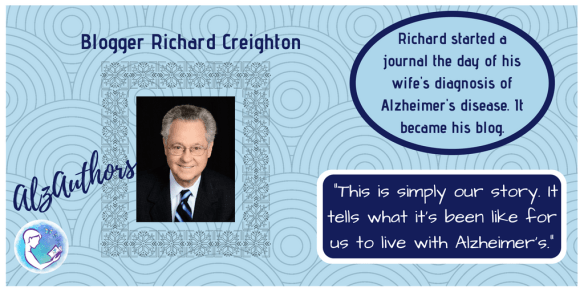
Why would a 78-year-old grandfather who doesn’t like to write become a blogger? The answer lies in my personal experience before my wife Kate was diagnosed with Alzheimer’s in 2011.

We played a major role in caring for our parents. There was a lot to learn. I felt we knew far too little about our parents’ experiences before our involvement in their lives. Kate and I were happy to have cared for them, but we wanted to make life easier for our own children. That meant keeping them knowledgeable about our lives. That, in turn, led me to start a journal the day of Kate’s diagnosis. This was a way to document our experiences for future reference.

After a year or two, I began to think that my journal might be of interest to others, especially those who are living with Alzheimer’s themselves. It was too much for a book, and I was continuing to make regular entries. A blog seemed like the way to go.

There are three things about our story that make it a little different from others. First, it is both an account of our post-diagnosis experiences, as well as a “real-time” account of what is happening every day. Second, ours is a story of optimism and joy. No couple escapes the challenges of dementia and the sadness that comes with it, but we have been able to live happily throughout our journey. Third, it is not a place to look for advice. I believe there are many other sources for that. This is simply our story. It tells what it’s been like for us to live with Alzheimer’s.

We’ve maintained an active lifestyle throughout our journey. Most of that has involved our everyday activities here in Knoxville. We attend most of the theatrical productions at three of our local theaters. In addition, we attend a variety of musical events that include opera, jazz, and Broadway. We have traveled a good bit over the course of our marriage. Since Kate’s diagnosis, we’ve enjoyed an African safari and trips to Machu Picchu, the Galapagos, and New Zealand. Our last and final international trip was to Switzerland in 2015, where we both paraglided off the mountain top overlooking Interlaken.

About a year after her diagnosis, we started eating out for all our meals except breakfast. For us, that has proven to be one of the best decisions I’ve made. The meals themselves have been secondary. The important thing is that it has helped to minimize stress and social isolation. It wouldn’t be for everyone, but it works for us.

We’ve been very fortunate. We continue to enjoy life and each other even though Kate’s memory is virtually gone. It is only now that we are reaching the hardest part of our journey. Our experiences may not be representative of others, but I am sure that almost any primary care partner will recognize the issues we have faced. If you get a chance, drop by sometime: Living with Alzheimer’s Blog.

photo 2 richard creighton jpgAbout the Author

Richard Creighton is a former college professor and business owner. He and his wife, Kate, met in college and have been married 55 years. They have a daughter and a son and five grandchildren.

Caregiving has been a central part of their lives since the Fall of 1989 when Kate’s father had a stroke. Three of their parents were cared for and died at home, his father in the hospital. Kate’s mother lived in their home for almost 5 ½ years with 24/7 care provided through an agency. Through those experiences Richard learned much about the health issues, living arrangements, and personal care for people with dementia.

Kate was diagnosed with Alzheimer’s two years before his dad died. He says that his experiences with their parents has helped him to be a better primary care partner for Kate. He is guided by his belief that there is no greater privilege than to walk with someone you love through the last chapters of her life.

Connect with Richard Creighton

Living with Alzheimer’s Blog

Twitter: @LivingWthAlz

Continue reading

From the AlzAuthors Blog: Meet Susan Cushman and Her Memoir “Tangles & Plaques”

cushman, susan

By Susan Cushman

My mother, Effie Johnson, was second generation Alzheimer’s. Her mother, Emma Sue (for whom I was named) died from Alzheimer’s when she was 87 years old in 1986, in the same nursing home in Jackson, Mississippi where my mother would spend the final eight years of her life. I remember watching my mother care for “Mamaw” and wondering what our future might bring.

Twenty years later, in 2006, I moved Mother into assisted living. My father had died of cancer in 1998, leaving Mother alone. After eight years of watching her gradual decline and taking on more of her day-to-day responsibilities, especially her finances, I offered first to move her in with us—which she declined—and second to move her to Memphis to an assisted living home. She begged me to let her stay in Jackson, which I did. This meant I would spend the next ten years making the 400-mile round trip to participate in her caregiving, although she did have help, first in assisted living, and finally in a nursing home. Continue reading

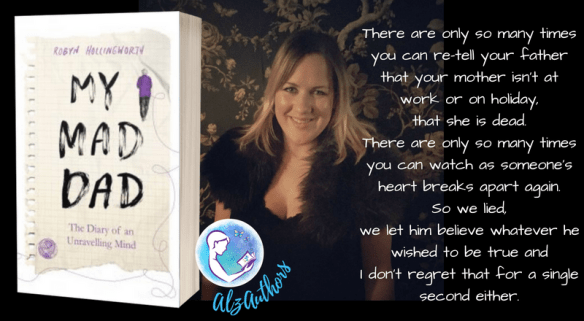
From the AlzAuthors Blog: Robyn Hollingworth and “My Mad Dad: The Diary of an Unraveling Mind”

My Mad Dad Canva

By Robyn Hollingworth

About ten years ago my life took a turn. I guess you would say it took a turn for the worse, but really, it just changed. I was in my mid-twenties, living in London and working in fashion. My father  was diagnosed with Alzheimer’s in his early 60s, and within the year, I had moved back to small-town south Wales to help my mum look after him.

His decline was swift, his actions included (at the start) repetition of stories, misplacing items, and accidentally putting on Mum’s cardigan to go to the shops – so far, standard! He had really mellowed and was fairly stoic and philosophical about the illness, often making jokes about his forgetfulness, even though it must have been terrifying for him. Then life took a turn for the “even worse.” Mum was diagnosed with terminal cancer and passed away just three months after I moved home. The effect this had on dad was profound and catastrophic. The seismic shift in the family dynamic tipped him right over the edge. By this point, my older brother was also in residence, but still we couldn’t give dad the level of care he needed. One day he mistook me for a burglar and came at me with a knife. It was at this point that we had to seek more help and Dad went into a care home. Continue reading