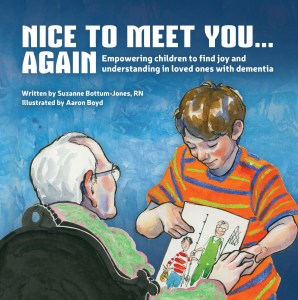
Suzanne Bottum-Jones Explains Dementia to Kids in “Nice to Meet You… Again”

Bottum-Jones Canva

By Suzanne Bottum-Jones, RN

Nice To Meet You… Again is the representation of years of sitting with families as a Registered Nurse, holding their hands, witnessing their frustrations, and sharing in their journeys through dementia. After fifteen years of wishing for a tool to help families learn strategies and see hope for their interactions, my father developed dementia, and I decided I needed to move my teaching outside of myself as the deliverer and multiply the effects that I, alone, could not make.  As I prepped for this, I remembered the countless families that made their final decision to stop visiting their loved ones because it was so upsetting to see the changes in their loved one and because of their fear of how these visits were affecting their children. This became my mission: to develop a tool that would help families change these moments of frustration by giving them the tools to help “see” a different expectation and journey, and change the flavor of their interactions.

bottum jones coverIn the short time the book has been available I have been blessed with  many responses from families of how they wished they would have had this resource when they were in this journey, or how it is currently changing their journeys and giving them back their joy with their loved one.  Professionals and family caregivers have stated they carry the book with them because hardly a day goes by in which someone they know or meet shares their journey of dementia. By offering this book, they state that they feel like they can finally do more then just say, “I understand;” in addition they can offer hope. Continue reading

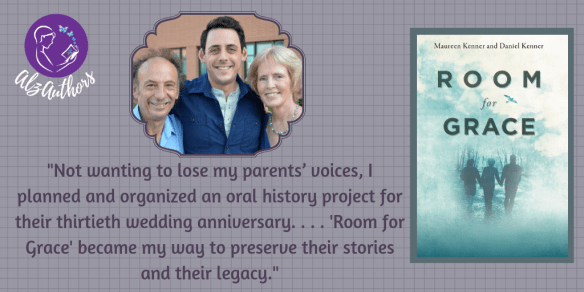
AlzAuthor Daniel Kenner Shares How He Used an Oral History Project to Preserve His Parents’ Life Stories & Legacies

Kenner, Daniel

By Daniel Kenner

After many long months of exhaustive family struggles, cognitive and behavior changes, and a lengthy process of medical evaluations and tests, my dad, Buddy, received the devastating diagnosis of Frontotemporal Lobe Dementia (FTD). It was Valentine’s Day, 2013. FTD is a rare neurological disease that affects personality and social behavior, speech and language comprehension, and executive functions involved in reasoning, decision-making, and planning. Never to be outdone, my mom, Maureen, always the fierce competitor, was diagnosed with Stage 4 colon cancer only four months later.

That year, my best friend’s parents died in a terrible plane crash and that sudden tragedy struck me in such a profound way. “I am going to lose my mother and my father,” I remember thinking, “but I still have time.” I don’t know which is worse: losing parents instantly or watching them slowly deteriorate, but I knew I wouldn’t squander the chance to say goodbye.

Dad was a natural storyteller, and through that he became my favorite story to tell. He was my hero. The highest compliment I can give of my dad was he had a son that idolized him. Everything he loved I was determined to love just as much or more: Bob Dylan, Lenny Bruce, Marlon Brando, absurdist theater, and the San Francisco 49ers. But dementia made him quiet and apathetic; he no longer expressed an interest in the things we used to do together. Continue reading

AlzAuthor Julie Bigham Shares How to Create Joy Filled Visits in the Midst of Alzheimer’s

bigham canva 2

By Julie Bigham

My passion for bringing joy to the lives of seniors began at an early age, when my gramps encouraged me to entertain at his Senior Center. Fifteen minutes of stand up, egged on by applause from the crowd, ignited a spark of love in my heart for the older generation. Thirty plus years later that spark has erupted into a full flame of passion for providing support to professional and family caregivers caring for loved ones living with Alzheimer’s.

Through my work experience as an activity professional, it became evident to me that providing high quality, compassionate care for those living with Alzheimer’s takes a village, and family engagement in any setting is vital. Families can become overwhelmed with doctor visits, medication changes, increasing care needs, and care plan meetings, not to mention the emotional stress. With everything they juggle, families can forget the importance of spending quality time having fun with their loved one, often spiraling into isolation and depression. Continue reading

Krysten Lindsay Hager Writes Dementia -Themed Fiction for Young Adult Readers

Dating the It Guy Canva

By Krysten Lindsay Hager

I started writing Dating the It Guy as a romance between a high school girl and the popular senior son of a senator, but I also wanted to include a storyline of having the main character deal with her grandpa’s recent dementia diagnosis. My grandfather moved in with us when I was Emme’s age because he could no longer live on his own. I decided to write about it years later just to get it out. In fact the first time I read a section of it to my mother, she left the room because it was too much to deal with. It’s tough to look back at memories like that sometimes.

So I finished the book, but set it aside for a while. Then two years ago, there was a pitch contest online and I decided to see if there would be any interest in this story. My publisher said she’d be interested in seeing it. At that time I had only published middle grade novels with her and wasn’t sure she’d want a young adult novel from me—after all there are a lot of publishers who aren’t fond of genre hopping. I remember when I sent it to my publisher I mentioned I hoped that this book would help someone else. My publisher wrote, “have I told you I love your writing?” Continue reading

AlzAuthor Rosalys Peel Shares her Alzheimer’s Caregiver Story in “Mike & Me”

FeaturedImageRosalysPeel

By Rosalys Peel

Every two minutes someone in America is diagnosed with Alzheimer’s. Most will face this discouraging illness with their wife, husband or partner at their side. And yet the typical “Alzheimer’s couple” has no idea how to make the most of what lies ahead.

This is the predicament my loving husband Michael and I found ourselves in when we discovered that Mike had been diagnosed with Alzheimer’s. Over 35-plus years of marriage we had always dealt with problems together. But now we were advised to start preparing ourselves for the day when Mike would surely be moved from our home to an outside care facility. We simply weren’t ready to accept that. Continue reading

With Recipes, Poetry, and Prose Author Miriam Green Shares her Alzheimer’s Story in “The Lost Kitchen”

Green, Mirian Meme

By Miriam Green

When my mom, Naomi, was first diagnosed with Alzheimer’s I felt relieved. The doctors had finally acknowledged what our family had surmised for almost a year—Mom was losing her memory. Ok, I thought, what now?

Little in our lives changed at first. Mom still rattled around in her kitchen, she was still an avid music lover, conversationalist, and sweet companion. She could maintain her household, and even stay by herself in the evenings when my dad, Jack, was busy. But the signs were everywhere.

There was the day she tried to unlock the front door to her apartment with the wrong key. It didn’t occur to her that she should try another one, or even ask for help. I was waiting patiently on the other side as she jammed that key into the door over and over, swearing in language I had never in my life heard her utter. Daddy rushed from the shower, thinking she’d hurt herself with all the screams. It took a while to calm her down.

What did change dramatically in my life was a commitment I made to visit my parents once a week. I traveled 2½ hours each way by public transportation to be with them. Mostly, I was there for Mom. Those were wonderful mornings. We would do all manner of activities together, ambling around the city, drinking coffee, and enjoying the sunshine. I used those visits to organize my parents’ kitchen and cook them food for the week.

cover 7b Top to Bottom FadeI was privy to Mom’s anxiety over her waning memory. I held her as she cried bitter tears and told me she felt confused. It was the first indication that our roles would soon be reversed, that I was losing my mom by degrees, that the only way forward was a painful decline that inevitably led to death.

It’s been more than seven years now. I’ve learned a few things along the way— to avoid questions in my conversations with Mom; how a person’s gait can define their ill health; that front-closing bras are an Alzheimer’s intimate friend; and how to judiciously use her memory loss for our gain.

I don’t think we can ever be prepared for the strange turns and curves life throws us, but I do know that it helps me to write about them. First came the poetry. Then, what was initially a project I started with my dad as a humorous initiation into the world of cooking and caring for a spouse with Alzheimer’s—we called it “The Man’s Emergency Cookbook”—eventually morphed into its current composition. Thus were born my cookbook and my weekly blog. I didn’t need to be alone in my frustrations, fears and struggles. I could connect with the community of Alzheimer’s patients, their families and caregivers who were only a short click away.

And through it all, I cooked. I took what Mom had taught me when she was still active in the kitchen and used that as a basis to experiment with easy recipes that fed my spiritual and emotional hunger. My book, The Lost Kitchen: Reflections and Recipes from an Alzheimer’s Caregiver, is a combination of recipes, poetry, and prose about my family and how we have shared the demands of Mom’s Alzheimer’s.

About the Author

Green, Miriam headshotMiriam Green writes a weekly blog, The Lost Kitchen,  featuring anecdotes about her mother’s Alzheimer’s and related recipes. Her blog also appears on the ALZ Blog from the Alzheimer’s Association.  Her poetry has been published in several journals, including Poet Lore, The Prose Poem Project, Ilanot Review, The Barefoot Review, and Poetica Magazine. Her poem, “Mercy of a Full Womb,” won the 2014 Jewish Literary Journal’s 1st anniversary competition. Her poem, “Questions My Mother Asked, Answers My Father Gave Her,” won the 2013 Reuben Rose Poetry prize. She holds an MA in Creative Writing from Bar Ilan University, and a BA from Oberlin College. Miriam is a 20-year resident of Israel, and a mother of three. You can find Miriam on Facebook and Twitter at @thelostkichen.


* * *

Continue reading

How Saying “Yes” Helps Caregivers: Introducing “Start With Yes!”

Braxton canva

From the AlzAuthors Blog

By Cathi Braxton and Tami Neumann

Janna, a resident in a memory care facility, woke up one night and found a few staff members congregated around the nurses station.  When a nurse asked Janna what was wrong, Janna told the group that there were alley cats outside her window making all sorts of ruckus.  Several of the nurses seemed dismissive of  Janna with their sideways glances and eye rolling, but one staff member, Terry,  approached Janna with a kind but concerned smile on her face.

“Janna, let’s go see what all that ruckus is all about.  I suspect alley cats get hungry at this time of night.”  With that the two of them headed back down the hallway and disappeared into Janna’s room. Continue reading

From the AlzAuthors Blog: Michelle Spray Writes About Her Novel “Lost Memories Found Hope: A Granddaughter’s Story of Love throughout Alzheimer’s”

Spray,MichelleCanvaFeaturedImage

By Michelle Spray

I truly feel honored to be included as an integral part of the AlzAuthors group. Not only have I written a book with will make my grandmother proud, I have lived the caregiving experience one hundred percent. I was Grandma’s primary caregiver for seven years and got my on-the-job training simply because I lived there. It was up to me. I learned how to cope, distract, exercise patience, and lean on hope to get through all the emotions of dementia and eventually an Alzheimer’s diagnosis. I understand the stress that families are going through, including worrying and grieving for the Grandma I knew even though she was still alive. The day she no longer recognized me is a moment that will forever be etched on my heart.

Lost Memories front cover 2018I didn’t want to write a sad book about Alzheimer’s because that had already been done, so I used the opportunity to write a fictional story based on Grandma’s Alzheimer’s. I included the funny things she’d say, or how sometimes, even in the midst of it all, she would have a quick reply or joke, that always took me by surprise. At the end of the day, it would be these funny moments that helped me through all times I felt like crying; waiting for the mailman who already came, having her accuse me of stealing her teeth, telling me that the golden years weren’t really golden but instead a little rusty. When I’d ask her how she was feeling, she would tap the table and say, “with my hands.” Oh, how I miss her. Continue reading

From the AlzAuthors Blog: Carol B. Amos Shares “H.O.P.E. for the Alzheimer’s Journey”

Amos, Carol graphic copy

By Carol B. Amos

My two brothers and I were devastated when our mother began displaying signs of Alzheimer’s disease in 2002. She lived alone in her home and her nearest adult child lived four hours away. We banded together to face this challenge head-on. We began a period of observing, investigating, collaborating, and careful listening to gain insight into the situation. We visited and called our mother more often. We each solicited advice from caregivers we knew and visited our local Alzheimer’s Association office.

My brothers and I worked hard to help our mother maintain her independence and remain in her home. We worked with her doctors, and after multiple attempts Aricept was prescribed. We hired a social worker and nurse to assist her. When “issues” arose, we never knew if an event occurred as she explained. This was extremely frustrating to us. Eventually a dangerous incident demonstrated that she could no longer live alone. It was difficult taking responsibility for our strong, independent mother. Continue reading

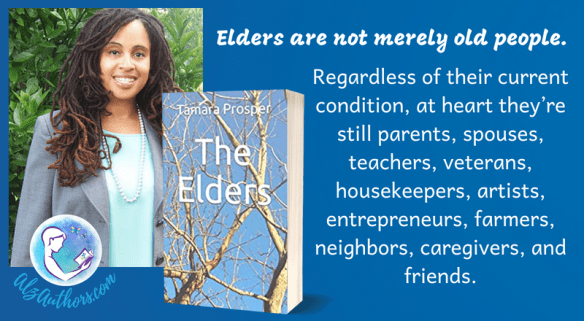
From the AlzAuthors Blog: Meet Tamara Prosper, author of “The Elders,” a Collection of Short Stories

Elders are not merely old people. Regardless of their current condition, at heart they’re still parents, spouses, teachers, veterans, housekeepers, artists, entrepreneurs, farmers, neighbors, caregivers, and friBy Tamara Prosper

Ever since I can remember trying to navigate through grief, frustration, anxiety, anger and sometimes even joy, writing has been the compass that lead me to equilibrium. Seven months after uprooting my family by moving from our home in a major southern city to take what I expected to be my dream job as the Administrator of a beautiful nursing home in rural North Carolina, I was exhausted, frustrated, angry and depressed. My children had quickly adjusted to our new environment. My husband seemed to be moving forward in his business endeavors. He and the children appeared to be quite content with everything except for the fact that I spent very little time with them. My friends lived far away and I had little time to make new friends so I poured my feelings into journals.

When saddened by the unexpected death of a resident, I wrote. When I was frustrated by demands from the corporate office, I wrote. When angered by the unrealistic expectations of resident’s family members and when my character was questioned, I wrote. When my staff was mistreated and when we celebrated our first deficiency-free annual state survey, I wrote. I wrote of individuals that I worked with before moving to North Carolina. I wrote my imagined explanations for the exasperating behavior of certain residents and their loved ones. I placidly withstood and gently addressed blatantly disrespectful behavior from a resident’s family member, then filled pages with the fury that had been veiled behind my calm demeanor. Hurt feelings, sweet memories, righteous indignation, joy, sorrow, celebration, dread, and voracious hope flowed from my spirit to my journals.

book cover (1)In nine months I had written and edited more than a dozen stories, finally choosing those that I believed were worthy of sharing with the world. I wanted people to see the humanity of elders and their caregivers. Elders are not merely old people. Regardless of their current condition, at heart they’re still parents, spouses, teachers, veterans, housekeepers, artists, entrepreneurs, farmers, neighbors, caregivers, and friends. They want what everyone wants – to enjoy a good meal, to laugh at a funny story, to spend time with loved ones, and to contribute to the world. Caregivers, whether professionals or responsible loved ones, are among the unrecognized heroes of our society. They give far more than they receive, simply because they know it must be done. By sharing varying perspectives and situations I seek to make these truths known.

By having a glimpse into the lives of The Elders, people may recognize someone they know or have a frame of reference for someone in the future. I want people to feel a connection with The Elders so they will empathize with and advocate for the elders in their communities.

Purchase The Elders

About the Author

Tamara G. ProsperI’m an Aging Services Professional with a sincere love for older adults and a resolute desire to see them thrive throughout all stages of life. I work directly with elders in organizations that support their care. I share as much information as possible with as many elders and caregivers as possible, to prepare, inform, educate and encourage them as they experience aging. I’m thankful to have received very positive feedback from readers.

Connect with Tamara Prosper

Twitter

Facebook

Facebook

Website

* * *

For more extraordinary books about Alzheimer’s and dementia please visit the AlzAuthors Bookstore.  Reposted with permission of AlzAuthors, the global community of authors and readers whose lives have been touched by Alzheimer’s and dementia. I am a co-founder and admin.

Continue reading